
Hybrid Work That Actually Works: Culture, Policy, and Technology That Sticks [Free Guide]
Most hybrid models don't fail. They just never really start.
This guide is for the people responsible for fixing that — HR directors, digital transformation leads, COOs, and managing partners who need a hybrid model that holds.
Your organisation announced a policy. Deployed the tools. Called it hybrid. And then watched, slowly, as nothing changed ... except that some people felt more visible than others, managers defaulted to what they knew, and "hybrid" started meaning different things to different people.
The failure is structural. Not cultural. Not technological.
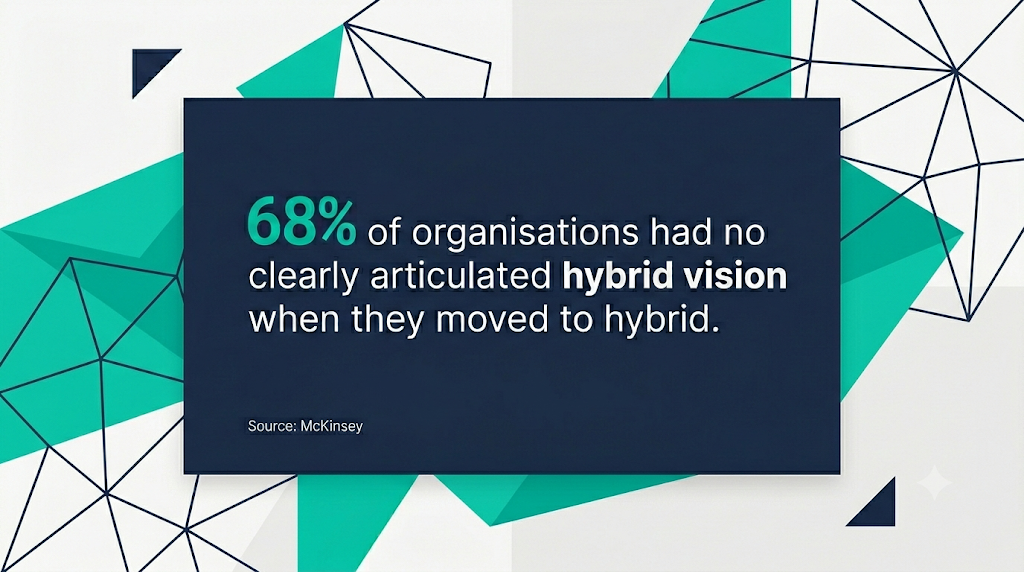
McKinsey found that 68% of organisations had no clearly articulated vision when they moved to a hybrid operating model. They had a policy — office days, a line in the handbook — but nothing that told managers how to run meetings across locations, how to onboard someone who joins mid-hybrid, how to assess performance without line-of-sight, or how to build a team that doesn't fracture along presence lines.
Three failure patterns appear consistently across organisations that have attempted hybrid adoption at scale.
Location-centric policies specify where people work but say nothing about how decisions get made, how knowledge gets documented, or how people who weren't in the room stay in the loop.
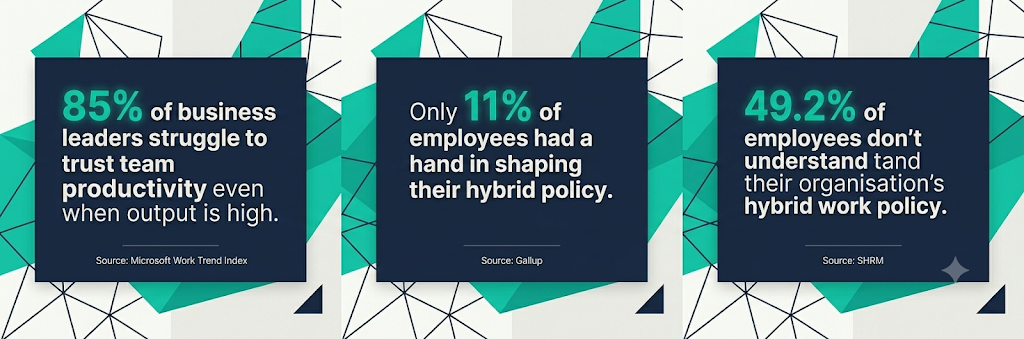
Under-equipped managers are asked to build trust across distributed teams, manage performance without visibility, and model behaviours they were never trained for. According to Microsoft's Work Trend Index, 85% of business leaders admit struggling to trust their teams' productivity, even when employee-reported output remains high. That is not a technology problem. It is a management capability problem.
Synchronous-by-default culture means every decision still goes through a meeting, every question still requires a live response, and every update is verbal, undocumented and unavailable to anyone who wasn't present.
None of these are solved by a new tool or a stricter attendance policy. They are solved by deliberate design.
This is the guide that takes you past the policy.
Hybrid Work That Actually Works is a practical implementation guide covering the culture, policy, technology, and management decisions that separate hybrid models that hold from those that quietly fail.
It addresses the failure patterns that appear consistently across organisations that have attempted hybrid adoption at scale, the culture and policy layers most commonly overlooked, the technology decisions that enable or hinder transformation, and the management frameworks that produce measurable results.
Competently designed hybrid work reduces attrition, widens the talent pool, and sustains or improves outputs. This guide is about what that looks like in practice.
What you'll be able to do after reading it
- Identify which of the three structural failure patterns is undermining your hybrid model; and why it may not have surfaced in your employee survey
- Write or audit a minimum viable hybrid policy that covers all five layers, not just attendance
- Build a hybrid tech stack that operates at communication, coordination, and documentation levels; and govern it so it changes behaviour, not just workflow
- Shift your management layer from attendance-based oversight to output-based performance, with the frameworks to do it
- Use the 90-day diagnostic scorecard to locate your implementation gap precisely
- Decide what in-person time is actually for; and design it so people value (rather than resent) it
- Make the case for continued hybrid investment using the metrics that actually matter: attrition, output quality, equity, and team cohesion
What's inside the guide
1. Why Hybrid Models Fail: The three structural failure patterns, and why most organisations are replicating a synchronous office culture inside a distributed operating model.
2. The Culture and Policy Layers: Why culture is the sum of behaviours and rewards, not a policy document; and what a minimum viable hybrid policy covers.
3. The Tech Stack: How to build a technology architecture that operates at three levels, and why deploying the right tools without updating communication protocols changes nothing.
4. Trust-Based Management and Async as an Enabler: The shift from attendance to output, the role of async communication in building distributed trust, and why weekly written updates eliminate more meetings than any scheduling tool.
5. Measuring What Matters: Why the default metrics — attendance, meeting load, tool-inferred activity — are unreliable, and what high-performing hybrid organisations measure instead.
6. What Good Looks Like: The operating characteristics shared by organisations where hybrid works, regardless of their tooling, office-day counts, or policy architecture.
7. The Implementation Gap: From Policy to Practice: The three root causes of the gap between stated hybrid strategy and lived employee experience, and the 90-day scorecard to close it.
The evidence is clear. The execution gap is where organisations lose.
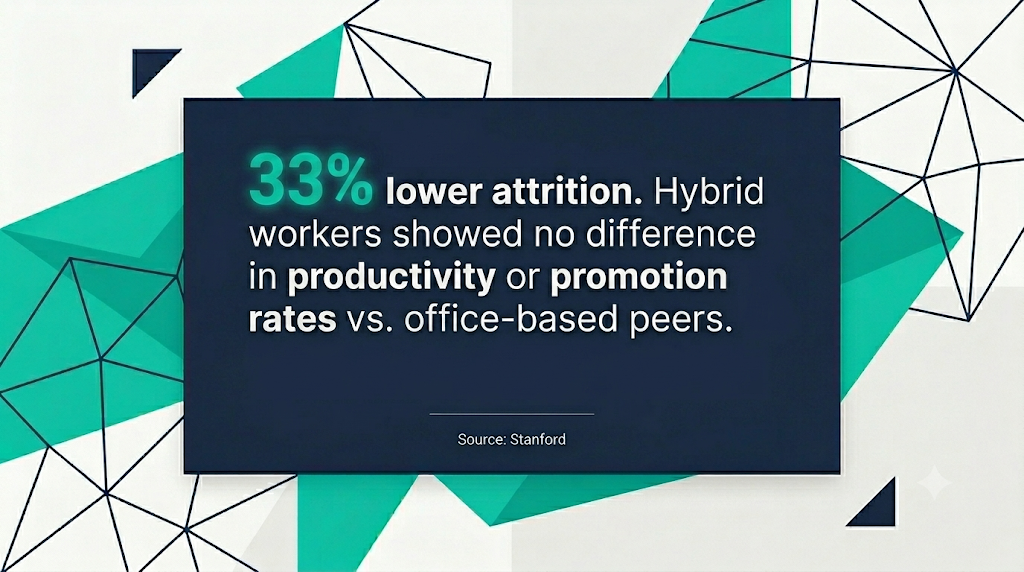
Seramount's 2026 review concludes that evidence increasingly points to neutral-to-positive outcomes for talent, productivity, and performance when hybrid systems are well designed. Stanford research found that hybrid workers showed no difference in productivity or promotion rates compared with office-based peers, while attrition fell by approximately one third.
These outcomes don't happen automatically. They happen when the management structure, communication architecture, and performance framework are built for them.
Common questions — addressed
"We've already done hybrid. We have a policy." Most organisations do. SHRM research found that 49.2% of employees still don't understand their organisation's hybrid policy. Having a policy and having a functioning hybrid operating model are not the same thing. This guide covers what sits between the two.
"Our managers are experienced. They'll adapt." Hybrid requires a different set of skills from office management — written communication, async decision-making, outcome-based performance assessment. Most organisations haven't invested in building them, and experienced managers aren't exempt from the gap.
"We have the tools, Teams, Asana, Slack." The most common technology failure in hybrid rollouts isn't deploying the wrong tools. It's deploying the right tools without updating communication protocols. The technology changes. The synchronous behaviour persists.
About this guide

Hybrid Work That Actually Works is published by Impellium Media as part of the Digital Working series — evidence-based reporting on the forces reshaping work.
Free. Instant access. Seven chapters, one practical framework per chapter.
Digital Working is written by William Alldred — journalist, writer, and B2B content adviser — and published every Wednesday.