The three-layer hybrid stack: why norms matter more than platforms [Part 3 of 7]
Most hybrid tech failures aren't about the wrong tools — they're about deploying the right tools with the wrong operating norms. This issue introduces the three-layer hybrid stack and a practical diagnostic to identify the gaps.

![The three-layer hybrid stack: why norms matter more than platforms [Part 3 of 7]](https://storage.ghost.io/c/1f/18/1f18af57-1089-4a2a-9070-c24228919e99/content/images/size/w1200/2026/06/ghost-featured-hybrid-tech-stack-three-layers-2026-06.png)
[Part 3 of 7 — Hybrid Work That Actually Works]
The firms that monitor keyboard activity are usually the firms where managers lack the skills to measure output directly.
Productivity surveillance — login tracking, presence flags, click counts — is often mislabeled as tech-assisted management. In fact, it is not. It’s tech-assisted mis-management. The impulse to measure activity rather than work is a symptom of a deeper problem that more technology won’t fix. Which raises an uncomfortable question for any organisation that has invested heavily in building their hybrid tech stack: is the stack solving the problem, or glossing it over?
The real failure mode
The most common tech failure in hybrid roll outs isn’t the wrong tools. It’s deploying the right tools while leaving communication norms unchanged.
Organisations often assemble platforms for messaging, video, project management, file storage, documentation, and more, only to watch hybrid friction accumulate. And the instinct to reach for another tool is almost always the wrong one. Every additional platform without an accompanying operating agreement is simply a new source of noise, a new way for losing context for teams to become disjointed.
Three layers, each with its own logic
An effective hybrid tech stack operates on three levels, each requiring its own tooling decisions and operating norms.
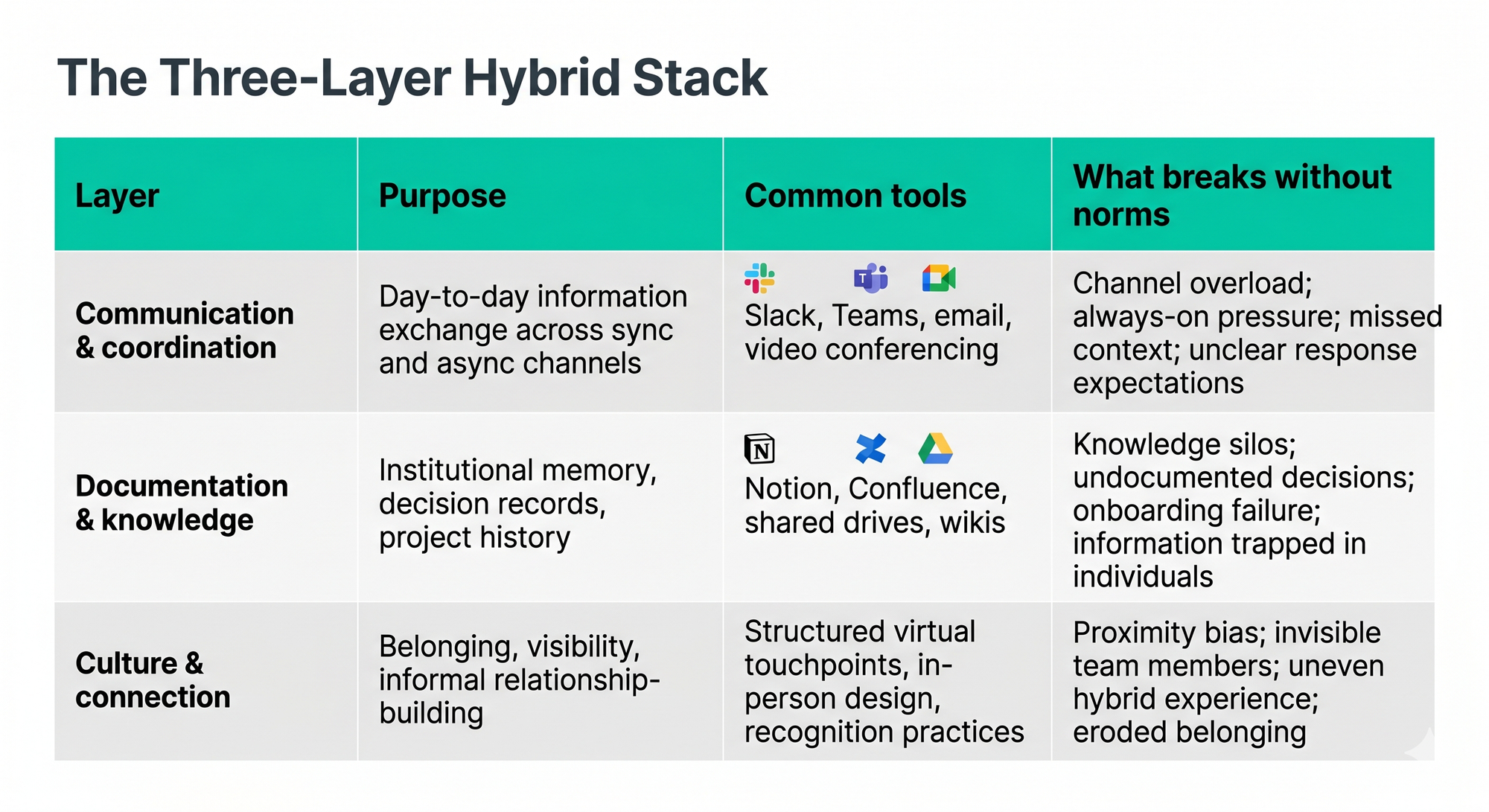
- The communication and coordination layer is where most hybrid investments land — and where most failures occur. The critical decision lies in matching tools with messaging; which types of tools to use and when. Without explicitly defining messaging norms, teams default to using every channel for everything: urgent requests buried in threads, decisions made in side conversations, adding to a constant anxiety about what’s been missed.
- The documentation and knowledge layer is often the most overlooked. Knowledge that exists only in people's heads remains inaccessible, leaving team members unable to retrace the steps towards a decision.
- The culture and connection layer is easily dismissed as trivial. However, Gartner found that 54% of HR leaders believe employees feel less connected to their organisation under hybrid arrangements. This finding is often cited as an argument for return-to-office mandates, but better read as an argument for intentional design. Connection does not require physical proximity. Only shared context, regular interactions, and rituals that carry meaning.
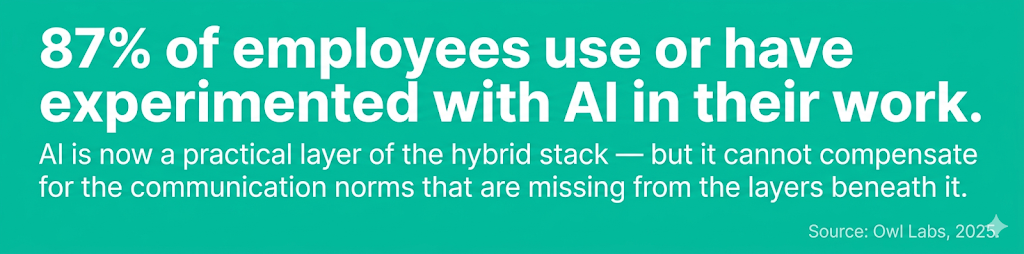
AI in the stack — but cannot replace missing norms
Transcription tools reduce the need for attendance. Summarisation tools compress async reading time. AI-assisted documentation can begin to close the knowledge gap, offering real operational gains.
However, AI tools only support existing communication structures. If these aren’t clear, AI will only accelerate the confusion. AI integration into the hybrid stack is non-negotiable. The question is whether the norms governing the rest of the stack are solid enough to make the integration useful.
Three questions per layer
A team that can answer yes to most of the following questions has a functional stack, regardless of which platforms it uses. A team that cannot is experiencing norm fragmentation, and adding more tools won’t help.
- Communication & Coordination
- Does each channel have a defined purpose, and does the team understand it?
- Is there a shared expectation for response times on async messages?
- Are sync meetings scheduled by default, or only when async is genuinely insufficient?
- Documentation & Knowledge
- Is there one agreed location where decisions and their rationale are recorded?
- Could a new team member find what they need without asking someone?
- Is documentation a shared team practice, or an individual responsibility that falls to the most conscientious person?
- Culture & Connection
- Are remote team members as visible as in-person ones in key conversations?
- Is in-person time designed for a specific purpose, or defaulting to attendance?
- Is belonging actively maintained through structure, or assumed to happen through proximity?
The three-layer stack is only as strong as the managers operating within it. The technology sets the conditions but trust is a different problem entirely.
Last issue we covered the five essential components of a hybrid working policy. Next issue: the trust gap in management, and the async habits that begin to close it.
The full implementation guide — Hybrid Work That Actually Works — covers all seven chapters, including the frameworks, checklists, and the 90-day implementation health check. It’s available as a free PDF. Download it here:https://www.impellium.com/hybrid-work-that-actually-works-ebook/