
The hybrid policy your team actually needs: five components, one missing [Part 2 of 7]
Most hybrid policies stop at working patterns. A functional hybrid policy has five components; the one almost always missing is the one that governs all the others


[Part 2 of 7 — Hybrid Work That Actually Works]
Two teams. Same employer. Same policy. Same tools.
One team knows what’s expected of them when they’re not in the office. They have clear norms around communication, a shared understanding of how performance is assessed, and a manager who behaves consistently whether the team’s remote or in the room. Work gets done. People feel visible.
The other team has the same handbook. The policy says two days in the office, three days remote. Beyond that, the norms are unspoken. Whether you’re visible depends on whether your manager remembers you’re there. Nobody has said this out loud, but everyone has noticed.
Same organisation. Two different cultures. One policy.
This pattern sits beneath most hybrid implementation failures. And it’s almost never about the policy itself.
The policy trap
When organisations talk about their hybrid policy, they almost always mean their working patterns: which roles are eligible, how many days are required in the office, what the core hours are. These rules matter. But they’re one component of a functional hybrid policy, not five.
This is a structural issue. Two-fifths of employers report that only some or a few of their employees can work flexibly in practice, despite flexible working being nominally on offer. The policy exists. The operating model doesn’t.
What fills the gap is not more policy. It’s the four components that most organisations don’t write down, don’t train managers on, and don’t hold anyone accountable to.
The five components
A minimum viable hybrid policy covers five things. Most organisations have one.
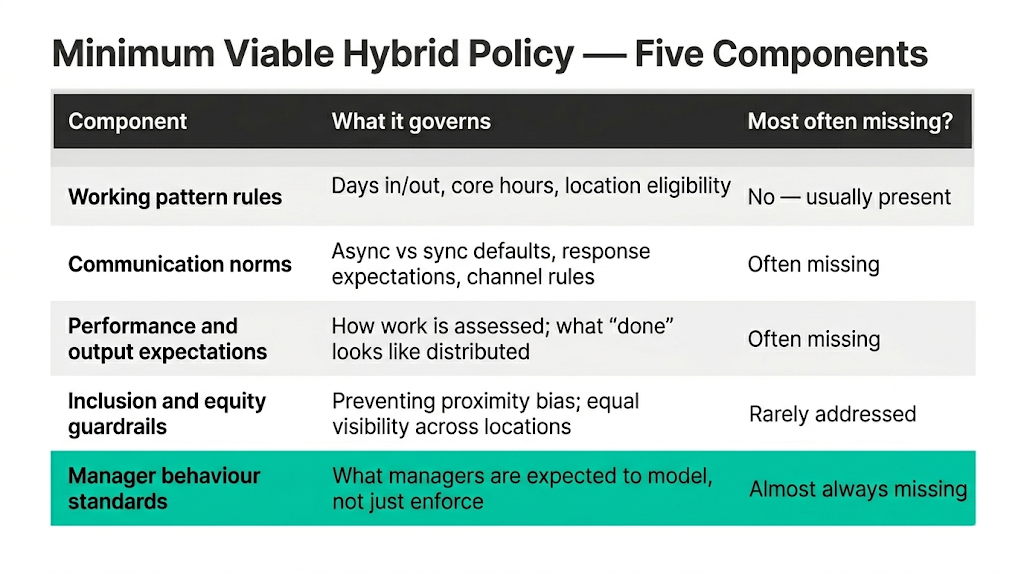
➡1. Working patterns (component one) are where most hybrid policies stop. The other four are where the operating model either takes shape or falls apart.
➡ 2. Communication norms determine whether async work is possible or whether behaviour quietly reverts to synchronous and always-on;
➡ 3. Performance and output expectations determine whether distributed employees are assessed on what they produce or on how visible they are;
➡ 4. Inclusion and equity guardrails determine whether employees who come in more often accumulate informal advantage over those who don’t.
➡5. And the fifth component (manager behaviours) is the one that governs them all.
Culture is what managers do
54% of HR leaders report reduced organisational connection under hybrid. This figure is routinely attributed to remote work, to distance, to tools. It’s more accurately attributed to the absence of managed norms.
Culture in a hybrid organisation isn’t what the CEO says in the all-hands. It’s not what the policy commits to paper. It’s what managers do when no one is watching, who they call, whose work they notice, how they run the team meeting when half the room’s on-screen.
The operating norm is set by what’s tolerated, modelled, and rewarded at team level.
When managers’ behavioural standards are missing from the policy, the policy is effectively silent on what matters most. That’s how the same policy produces differing cultures. The document’s identical. Managers’ behaviours aren’t.
What a complete policy looks like
Organisations that address the five components don’t tend to have more elaborate policies. In fact, they tend to have shorter, more specific policies.
They outline expected communication norms, not just permitted working patterns. They define what good performance looks like when the work can’t be observed directly. They acknowledge that proximity brings an informal advantage. And they build in checks to correct for it.
And they hold managers accountable for their behaviour, not just their output.
None of this requires a policy rewrite from scratch. It simply requires an honest audit of your current situation and where each of the five components fit into your set up.
Last week we covered the three structural patterns behind most hybrid failures. Next week: what the technology stack does — and doesn't — solve. Issue 3 examines why deploying the right tools while leaving communication norms unchanged is the most common technology failure in hybrid rollouts.
The full implementation guide — Hybrid Work That Actually Works — covers all seven components of a functional hybrid model, including the frameworks, checklists, and a 90-day health check scorecard. Get yours free: https://www.impellium.com/hybrid-work-that-actually-works-ebook/



![The three-layer hybrid stack: why norms matter more than platforms [Part 3 of 7]](https://storage.ghost.io/c/1f/18/1f18af57-1089-4a2a-9070-c24228919e99/content/images/size/w600/2026/06/ghost-featured-hybrid-tech-stack-three-layers-2026-06.png)