The four things organisations that make hybrid work have in common [Part 6 of 7]
Same hybrid policy, different results. The organisations getting hybrid right share behavioural traits, not structural ones. Here's the four-stage maturity model that explains the gap.


Part 6 of 7 — Hybrid Work That Actually Works
Two organisations run the same hybrid policy. Three days in the office, two remote, a communication from the CEO, a shared collaboration suite. Twelve months later, one has lower attrition and a leadership team that genuinely trusts its direct reports. The other harbours quiet resentment and a policy nobody quite follows. Same rules on paper. Different organisations underneath.
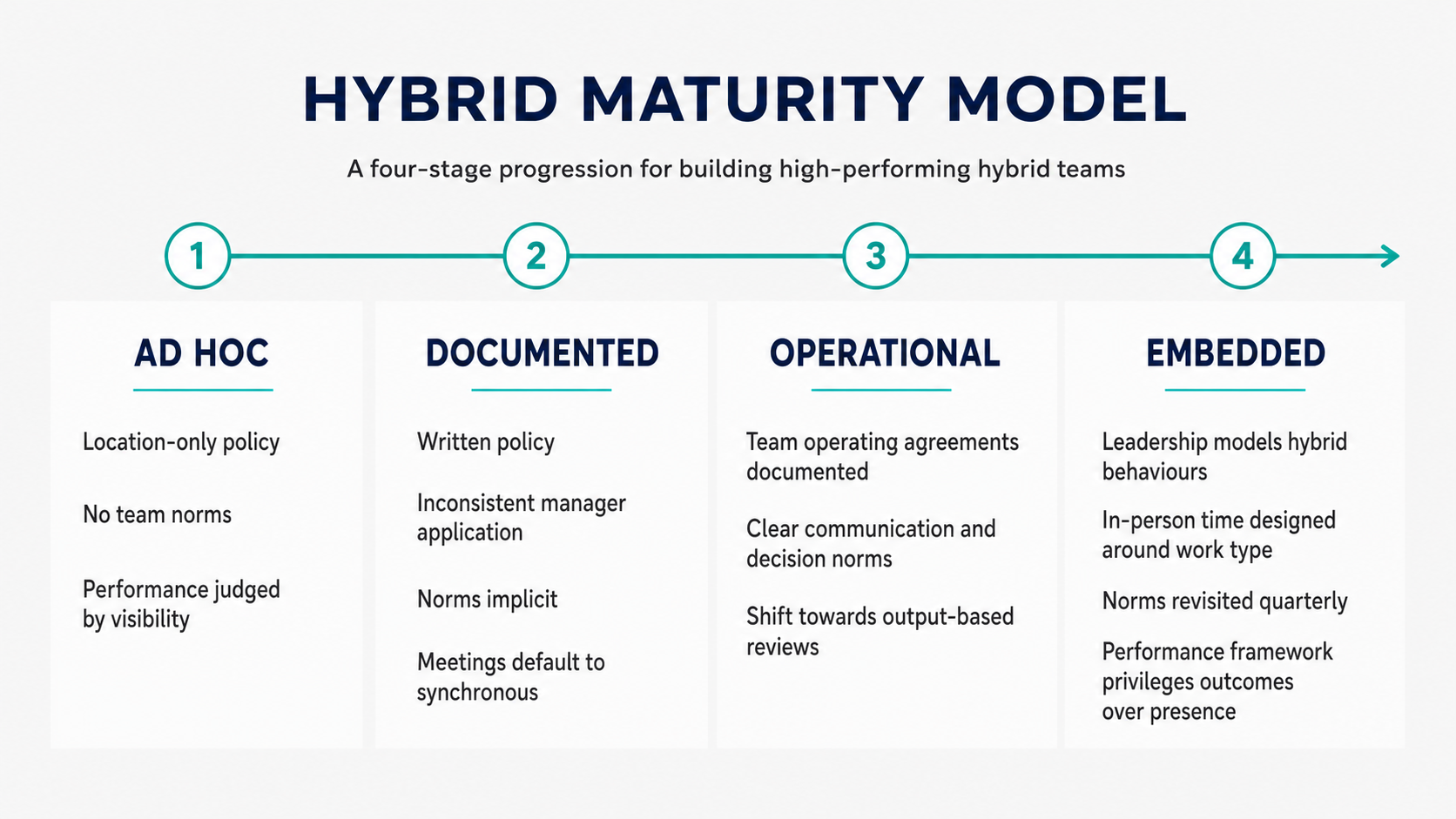
The crucial question isn't whether you have a hybrid policy, nearly everyone does by now. It's which stage of the maturity curve you're actually operating on, because that predicts the outcome far more reliably than the policy itself.
The differentiator is behavioural, not structural
Organisations that make hybrid work well don't share similar headcount, tooling budget, or number of office days. They share behaviours that show up consistently at every level, from how managers run one-to-ones to how leadership approaches in-person attendance.
The clearest sign of this shift is a reframe most organisations haven't made. High performers stop asking how many days in the office and start asking what kind of work needs doing, and where. Deep focus work benefits from location agility. Relationship-building, creative collaboration, and onboarding benefit from physical co-presence in ways async tools can't fully support. Once that distinction becomes clear, in-person time stops being a compliance exercise and becomes deliberate design.
Documented norms, not policy documents
The second differentiator is whether operating norms are documented and shared at team level — distinctly from the company policy. A policy sets boundaries: eligible roles, working patterns, minimum expectations. A team-level operating agreement captures how a specific team actually works; from decision making, to channel use, to performance assessment. The organisations getting this right treat this agreement as a living document, revisited quarterly, with deviations handled as process errors rather than deviations from policy.
The third differentiator carries the most weight culturally: the performance review cycle. A framework that still privileges co-presence — who was seen, who answered fastest — creates the culture problems critics point out. A framework that privileges results favours the retention and engagement outcomes desired. Gallup's research provides a useful gut-check: only 11% of employees currently benefit from a hybrid arrangement they had any hand in shaping. This means most organisations operate on a model that inhibits the outcomes they say they want.
The fourth differentiator pertains to the behaviour of the leadership. A leader who models ideal async communication habits and documents their decisions gives everyone else permission to do the same.
Not a budget problem
None of this requires a large tooling budget or an increase in headcount. The gap between where most organisations are and the benchmark is born from a shortfall in design, not in technology or budget. The fix is available to any organisation willing to do the unglamorous work: naming which type of work goes where, writing down team-level norms, rebuilding review cycles around output.
Most organisations, honestly assessed, will place themselves at Stage 1 or Stage 2.
Next week closes the series with a diagnostic: six questions that locate exactly where your organisation's implementation gap sits, whether at the 90-day mark or any point thereafter.
The full guide — Hybrid Work That Actually Works — is available as a free PDF. Download it here: https://www.impellium.com/hybrid-work-that-actually-works-ebook/


![The three-layer hybrid stack: why norms matter more than platforms [Part 3 of 7]](https://storage.ghost.io/c/1f/18/1f18af57-1089-4a2a-9070-c24228919e99/content/images/size/w600/2026/06/ghost-featured-hybrid-tech-stack-three-layers-2026-06.png)