
The hybrid metrics that lie — and the four that don’t [Part 5 of 7]
Attendance, meeting load, and activity tracking feel relevent but tell you nothing about whether hybrid is working. Here's what to measure instead — and the attrition number that makes the ROI case.


Part 5 of 7 — Hybrid Work That Actually Works
A leadership team gathers to review its hybrid model. Badge-swipe data looks stable. Calendars are full. Login hours, if anyone checks, are healthy. Everyone nods. But nobody in the room can answer the only question that matters: is this actually working?
That gap isn't a data problem. It's a measurement problem, built into the metrics themselves.
The metrics that feel objective but aren't
Most hybrid organisations default to three measures: attendance, meeting load, and tool-inferred activity. All three feel relevant. Yet none are reliable.
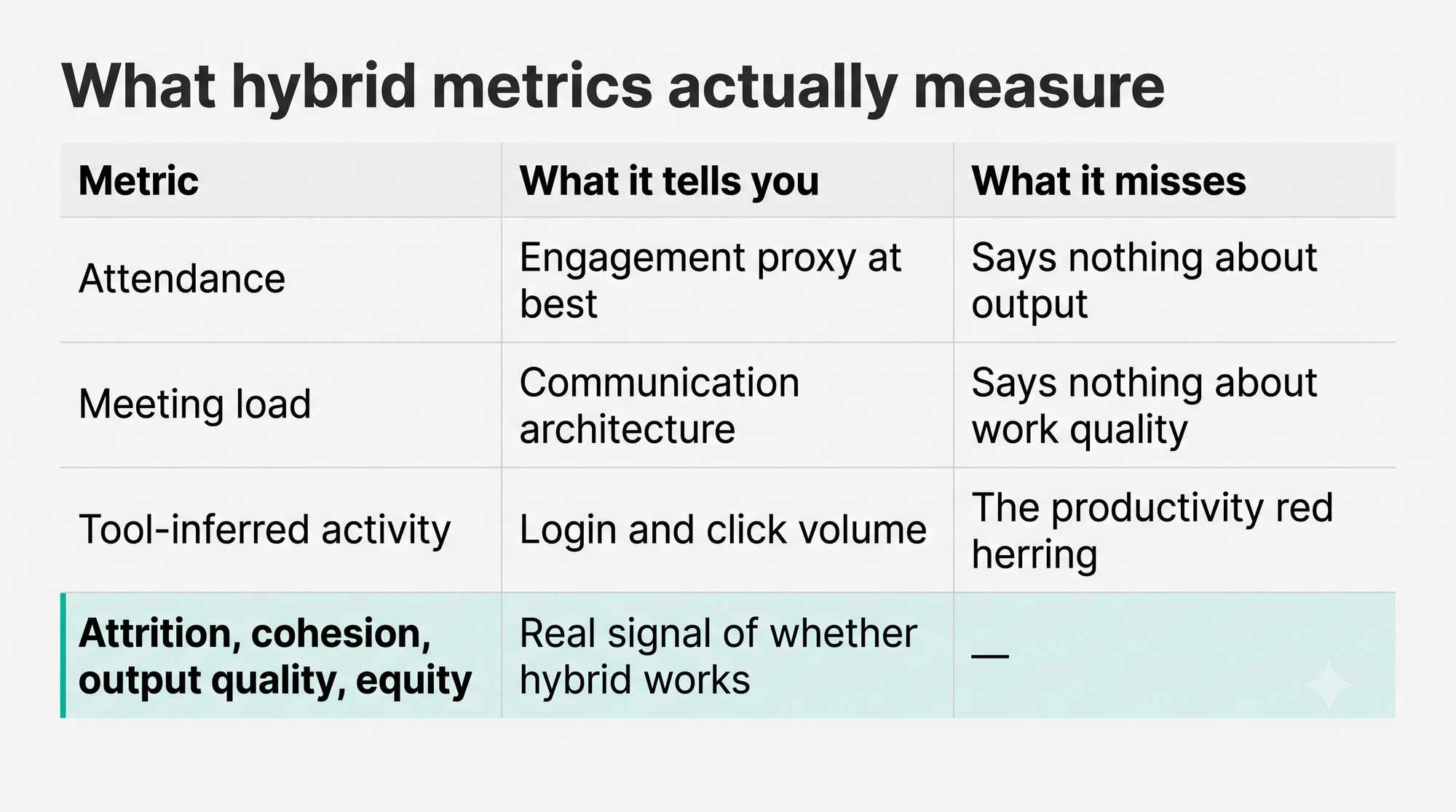
Attendance is, at best, a proxy for engagement, not a measure of output. Meeting load reveals how well the communication architecture works, not whether the work produced is any good.
And tool-inferred activity (keyboard clicks, login hours) is what Microsoft's own research has called the productivity red herring: a number that correlates with almost nothing a board really cares about.
The firms that lean on this kind of surveillance are usually the firms whose managers lack the skills to assess output effectively. It's a management issue disguised as tech rhetoric.
What good measurement looks like
Organisations that measure hybrid well look elsewhere: output quality, team cohesion, attrition patterns, project or customer outcomes, and equity of access across roles. None of these need a dashboard. All of them need managers willing to have direct, evidence-based conversations rather than relying on the ambient cues that proximity used to provide.
Of these, attrition speaks the loudest in a boardroom. It's concrete, it's financial, and it's the clearest case for continued investment in a hybrid infrastructure.
Stanford research sharpens this further: organisations that implement hybrid well see attrition fall by roughly a third. That figure alone tends to reframe the conversation from cost to return. Removing flexibility without a clear performance rationale risks losing precisely the people an organisation can least afford to lose.
There's a second benefit that rarely reaches the board but should. CIPD's 2025 research found that a majority of UK employers now see advertising a role's flexibility as important for attracting talent and closing skills shortages. Flexibility doesn't just retain people. It widens the pool an organisation can recruit from, without relocation costs attached.
What follows
None of this means abandoning data and KPIs. It means measuring the right things. Boards don't respond to activity metrics; they respond to attrition curves, retention data, and evidence that the talent pool has genuinely widened. That's the case hybrid infrastructure can make for itself, if the right numbers are presented.
This is Part 5 of 7 in the Hybrid Work That Actually Works series. Next week: what good looks like — the characteristics that separate organisations that make hybrid work from those that don't.
The full implementation guide — Hybrid Work That Actually Works — is available as a free PDF. It covers all seven chapters, including the frameworks, checklists, and diagnostic tools in full. Download it here: https://www.impellium.com/hybrid-work-that-actually-works-ebook/

![The three-layer hybrid stack: why norms matter more than platforms [Part 3 of 7]](https://storage.ghost.io/c/1f/18/1f18af57-1089-4a2a-9070-c24228919e99/content/images/size/w600/2026/06/ghost-featured-hybrid-tech-stack-three-layers-2026-06.png)