
Hybrid work — why most models fail: the three structural patterns [Part 1 of 7]
Most hybrid models fail not because organisations lack tools or commitment; but because leaders treat location policy as strategy. Three structural patterns explain almost every failure. This issue names them.


[Part 1 of 7 — Hybrid Work That Actually Works]
A client announces a hybrid project with eagerness. They write the policy, buy the tools, and a communication goes out from the CEO. And then, slowly, nothing changes. Communication norms remain. Managers return to what they know. And twelve months in, the organisation carries on working exactly as it did — all but in name.
This isn’t an isolated story. It is, in fact, the dominant narrative.
McKinsey found that 68% of organisations had no clearly articulated hybrid vision or plan as they moved to a hybrid operating model. Furthermore, SHRM states that nearly half of employees (49.2%) cannot explain their own organisation's hybrid work policy. These aren’t communication failures. They are structural failures. Somewhere between announcement and implementation, the policy substituted for the strategy.
Three patterns explain almost every hybrid failure. They aren’t isolated but compound each other. They are identifiable and fixable.
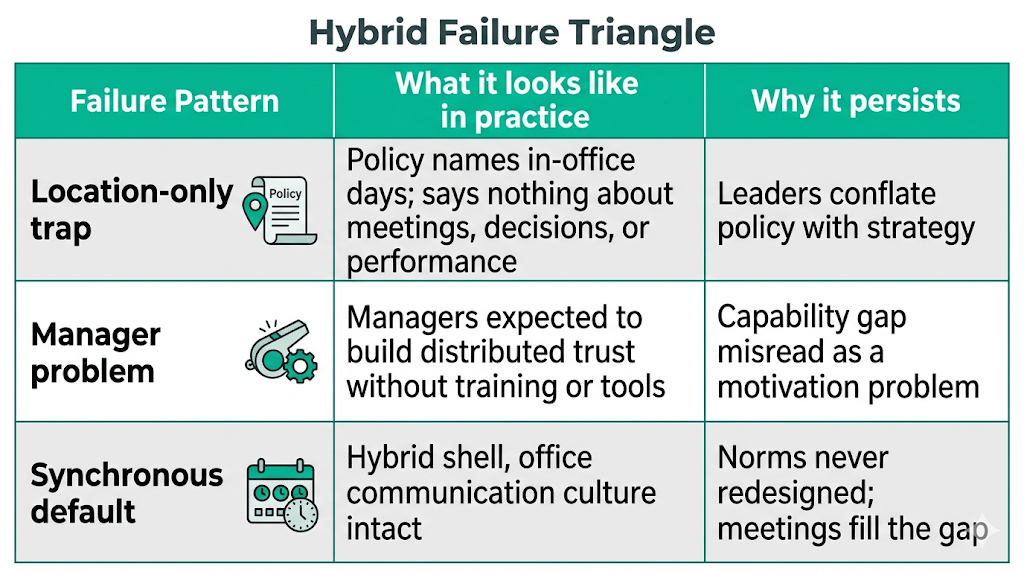
The location-only trap
The most common hybrid policy in use focuses on which days employees should be on-site, but says little else. It doesn’t address how meetings are run, decisions documented, performance assessed, or how new employees should be onboarded in a distributed environment.
The result is a two-tier workforce split between those who were present before the hybrid transition and those who weren't. Research from the Harvard Business Review shows how hybrid environments widen gaps in informal learning, onboarding, and access to context when organisations do not design deliberately for them. Even when the policy creates the appearance of flexibility, the operating model remains unaltered.
The manager's problem
Hybrid places significant new demands on middle managers, who are the people least equipped to meet them. They are expected to build trust across teams, manage performance without visibility, communicate across working patterns, and model behaviours they were never trained in — often with minimal support.
Microsoft's Work Trend Index found that 85% of business leaders admit struggling to trust their team's productivity, even when output data remains high. That trust gap is hardly a technology issue. It is much more of a management issue. And it is rarely addressed in hybrid rollouts, which focus instead on platform, policy, and location.
The synchronous default
When organisations implement hybrid without redesigning their communication habits, they replicate the synchronous culture inherited from the office. Every decision still goes through a meeting. Every question still requires a real-time response. Every update is verbal and undocumented. In effect, the distributed hybrid policy is in place while the office culture remains.
What the organisations that get hybrid right do differently
The organisations operating hybrid well share three characteristics: 1) They treat the policy as infrastructure; a live document governing how decisions are made and how work is communicated, not a rulebook about location. 2) They invest in managerial skills before attrition or engagement issues show up. 3) They redesign communication protocols deliberately: which channel carries which kind of information, what gets documented, and what does not need a meeting.
None of this requires a large budget; simply an acknowledgement of the distinction between a hybrid policy and a hybrid operating model.
Next week: Most hybrid policies address one of the five components that govern how a distributed team operates. Issue 2 covers all five, plus the one that is almost always missing.
This issue is Part 1 of 7 in Hybrid Work That Actually Works: a serialised guide to hybrid implementation for leaders and the consultancies that advise them. The complete guide — all seven chapters, frameworks, checklists, and diagnostic scorecard — is available as a free PDF. Download it here.



![The three-layer hybrid stack: why norms matter more than platforms [Part 3 of 7]](https://storage.ghost.io/c/1f/18/1f18af57-1089-4a2a-9070-c24228919e99/content/images/size/w600/2026/06/ghost-featured-hybrid-tech-stack-three-layers-2026-06.png)