
The trust problem in hybrid work — and the 15-minute habit that closes it [Part 4 of 7]
The management challenge in hybrid is more about trust than visibility. This issue explains why async communication is a trust-building infrastructure, and introduces the weekly written update: the 15-minute habit that replaces most status meetings.


[Part 4 of 7 — Hybrid Work That Actually Works]
The difference between hybrid models that work and those that don't is most clearly visible at the leadership layer.
Not in the tools deployed. Not in the number of mandated office days. Not in the policy document. In the behaviour of the people who run teams, how they communicate, how they document decisions, how they show up in the spaces their teams actually work in.
Two leaders in the same organisation, with identical policies and identical platforms, will produce completely different outcomes. One team operates with clarity, trust, and genuine location agility. The other drifts. Attendance becomes a proxy for commitment, decisions happen in corridors, and the people not in the room are always slightly behind. Both would describe themselves as managing a hybrid team.
This issue is about why that gap exists — and what closes it.
The trust problem isn't what you think
The central management challenge in hybrid is not visibility. It is trust. And they are not the same thing.
Visibility — knowing who is at their desk, when they logged on, how many hours they spent in meetings — tells you almost nothing about whether the work is good. In a distributed environment, it becomes actively misleading: a proxy for presence, dressed up as a proxy for performance.
Trust is about something simpler and harder: do you know what your people are working on, what's blocked, and what's coming next? And do they know the same about you?
In a distributed environment, trust erodes not from malice but from information asymmetry. When decisions aren't documented and updates only happen verbally, the only people who know what's going on are the people who were in the room. Trust degrades quietly, and usually before anyone notices it has started.
Microsoft's Work Trend Index found that 85% of business leaders admitted struggling to trust their teams' productivity, even when employee-reported output remained high. That is not a motivation problem. It is a structural one. The infrastructure that would build trust — shared context, documented decisions, visible progress — is missing.
Async as infrastructure, not workaround
Asynchronous communication is often framed as a concession to remote workers. It isn't. It’s the structural layer that makes trust possible.
When decisions are documented and updates recorded, the information asymmetry that erodes trust is eliminated. People who weren't in the meeting can reconstruct what was decided and why. People on different schedules are working from the same version of truth. Physical proximity is replaced (not perfectly, but adequately) by a written record anyone can access.
Most organisations aren't there yet. Gallup found that only 11% of employees benefit from a hybrid policy they had a hand in shaping; the arrangement most likely to produce positive outcomes and most likely to be perceived as fair. The implication: most hybrid operating models are running outside the management structure best suited to make them work. The infrastructure wasn't built for the model.
Building it doesn't require a new platform. It requires a practice.
The 15-minute habit
The simplest, highest-leverage entry point for most teams is the weekly written update.
The format is deliberately minimal. Each team member writes a short structured summary once a week. It takes under 15 minutes to produce and two minutes to read. It doesn't replace one-to-ones or strategic conversations. It replaces the check-in meeting, the 30- or 45-minute status call that exists primarily to relay information that could have been written down.
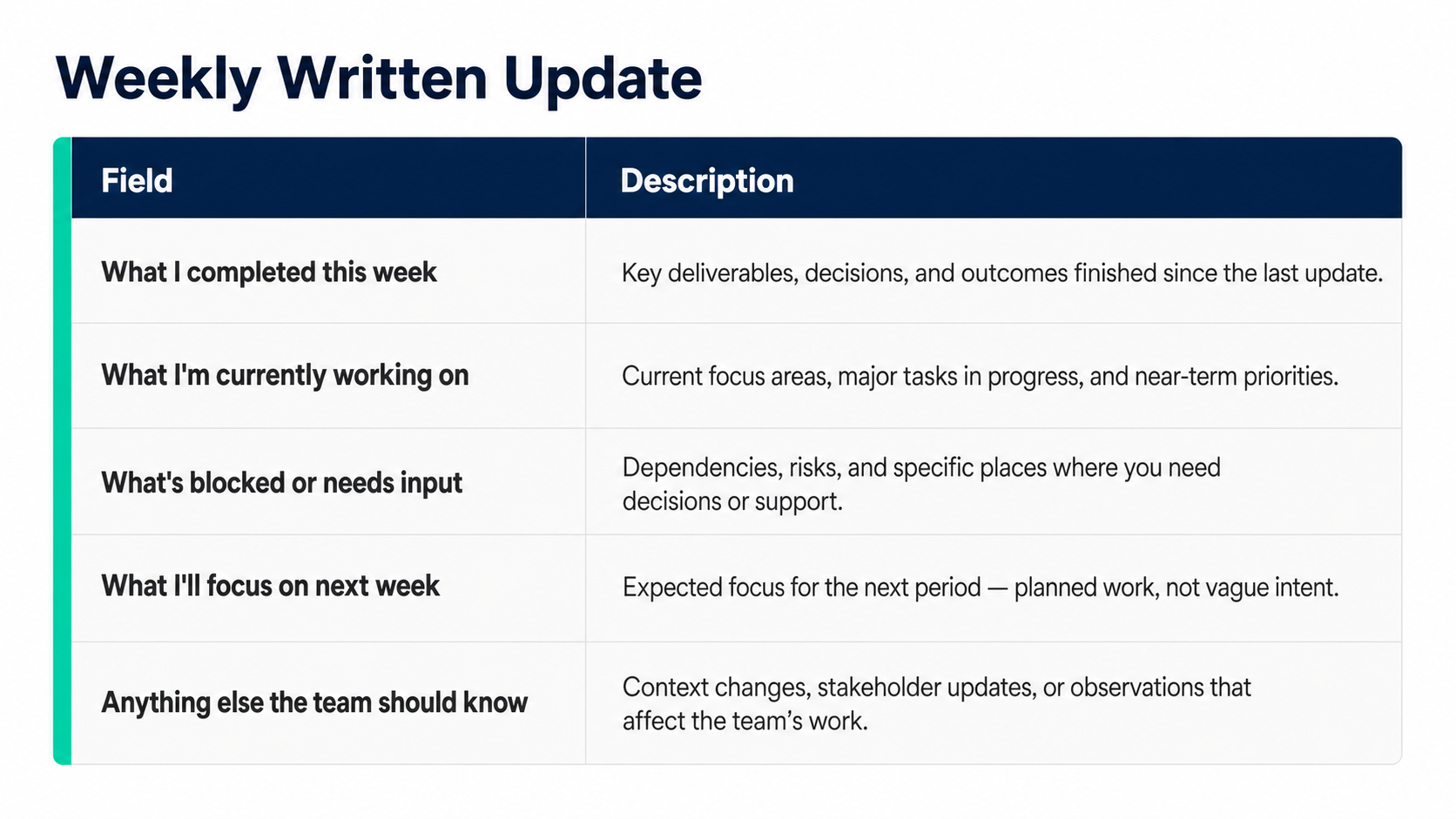
The value is not just in efficiency. A written update creates a record. Blockers surface before they become delays. Progress is visible without anyone having to chase it. And the whole team — wherever they're working — operates from the same shared context.
Done consistently, this single habit changes the information architecture of a distributed team more than any one tool.
Leadership sets the tone
None of this works if it stops at the team level.
Leaders who model async communication well, who write their own updates, document their decisions, and participate openly in async channels, give permission for the rest of the organisation to behave the same way. They signal that this is how work happens here.
Leaders who treat hybrid as a policy only for others, while defaulting to in-person habits themselves, produce a two-tier culture. Not deliberately, but structurally. The informal channel becomes the real channel, and anyone not physically present is working at a permanent information deficit.
Stanford's hybrid work research found roughly a 33% reduction in attrition where performance infrastructure is built around distributed work. That result doesn't follow from a policy update or a new platform purchase. It follows from management design: building the systems that make output visible and trust sustainable without requiring physical proximity.
The weekly written update is one of those systems. It isn't a complete answer. But it is a tractable starting point that costs almost nothing and generates a compounding return.
This is Part 4 of 7 in the Hybrid Work That Actually Works series. So far: why hybrid models fail, the culture and policy layer, and the technology stack. Next week: how to measure whether hybrid is actually working — and what most organisations are measuring instead.
The full implementation guide — Hybrid Work That Actually Works — is available as a free PDF. It covers all seven chapters, including the frameworks, checklists, and diagnostic tools in full. Download it here: https://www.impellium.com/hybrid-work-that-actually-works-ebook/
![The three-layer hybrid stack: why norms matter more than platforms [Part 3 of 7]](https://storage.ghost.io/c/1f/18/1f18af57-1089-4a2a-9070-c24228919e99/content/images/size/w600/2026/06/ghost-featured-hybrid-tech-stack-three-layers-2026-06.png)